How can a city with limited land, high cooling demand, and almost no local fossil fuel resources keep the lights on while cleaning up its electricity?
That is not a theoretical puzzle. It is the daily design problem facing Hong Kong, and a growing number of Asian megacities. Towers need air conditioning. Rooftops and coastlines cannot host endless solar and wind farms. Fuels and, increasingly, electricity arrive from elsewhere. Climate targets still have to be met.
This article looks at what Hong Kong’s recent record actually shows, and what other dense cities can learn from it.
1. Why Hong Kong is an important energy transition case
Hong Kong is a dense, service driven city. It does not run on heavy industry. That makes electricity the centre of its climate challenge: power generation accounted for about two thirds of carbon emissions in 2019, and electricity related emissions were still about 61% of total greenhouse gases in 2023.
Three features make the case useful beyond Hong Kong’s borders.
Density limits local renewables. There is little spare land for large solar or wind farms. Clean electricity has to be planned under scarcity, not abundance.
Energy is largely imported. Hong Kong does not have meaningful domestic oil, gas, or coal resources. Reliability depends on supply chains and, increasingly, on electricity links with neighbouring systems.
Cooling is not optional. In a subtropical high rise city, air conditioning is infrastructure. Heat and electricity demand rise together.
Many Asian cities share versions of this pattern. Hong Kong is not a model to copy wholesale. Its power regulation and regional relationships are specific. It is valuable as a stress test, a place where the hard trade offs show up early.
Can a high density city keep electricity secure and affordable while moving away from fossil fuels?
2. Progress without a renewable boom
Start with the outcome that matters for climate policy: emissions fell.
Total greenhouse gas emissions peaked in 2014 and were about a quarter lower by 2023. They edged down again in 2024. The steepest drop came from electricity. Power related emissions fell by roughly a third from the 2014 peak, while remaining the largest source.
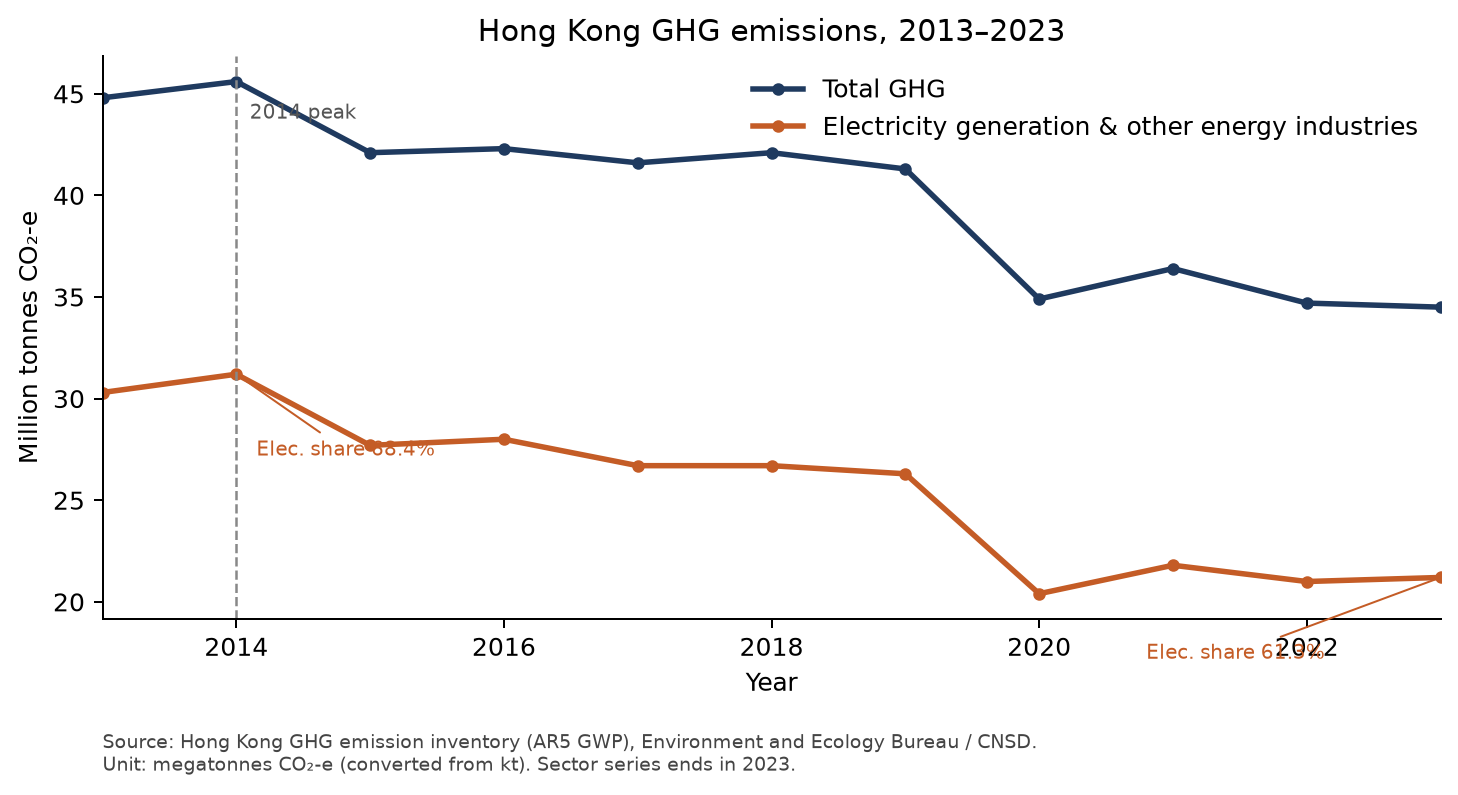
How did that happen? Not mainly through rooftop solar.
Over the past decade, local power generation shifted from coal to natural gas. Official updates tell the same story: coal has fallen from about half of the electricity fuel mix in 2015 to about one fifth recently, while gas has risen from about a quarter to more than half. The government aims to stop using coal for daily generation by 2035 or earlier.
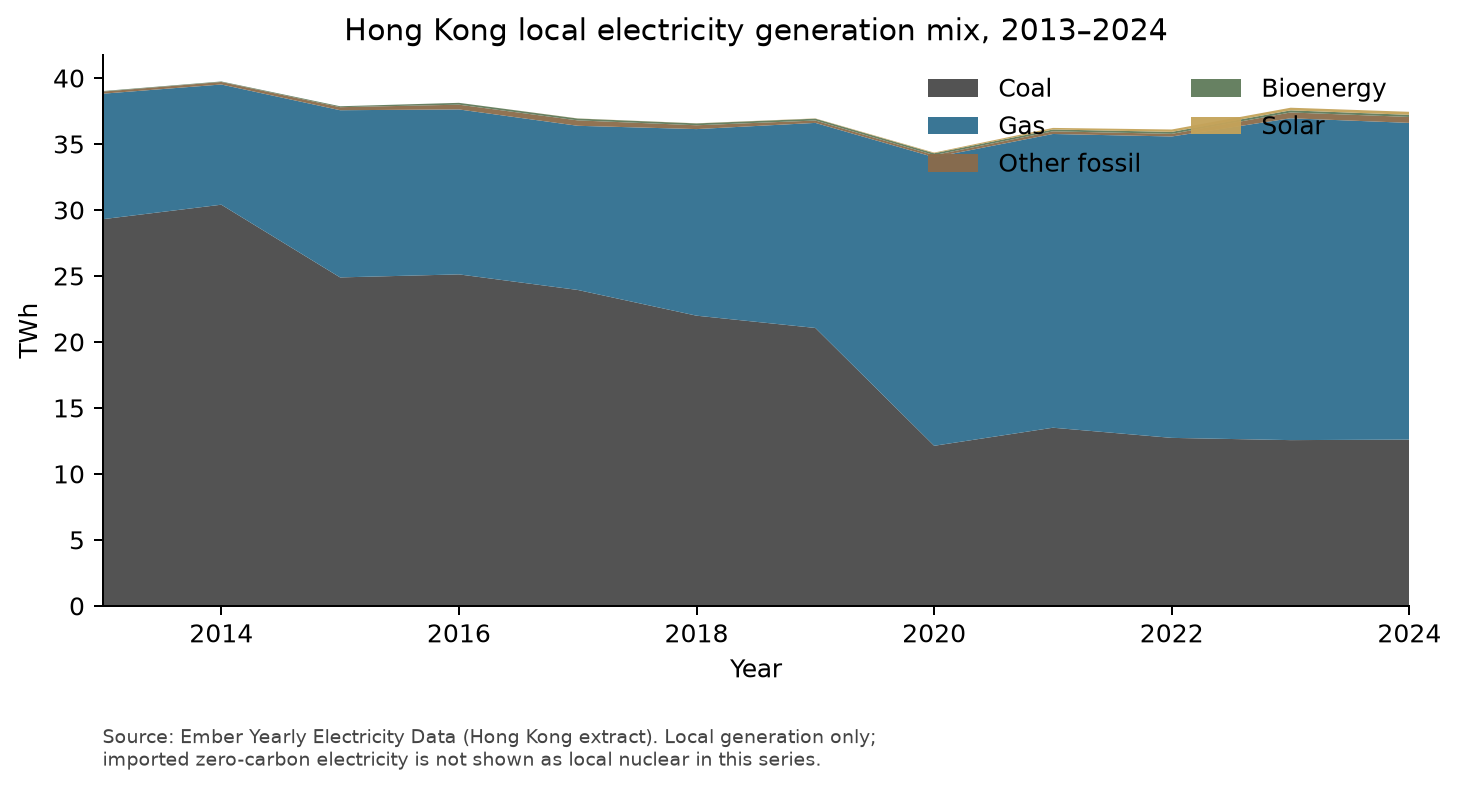
Demand did not explode in the meantime. Electricity use rose less than 7% from 2013 to 2023. Commercial users still account for about two thirds of that demand.
So the recent transition is best described honestly: a managed move from coal to gas, with clear climate benefits. It is not yet a renewable transformation of local supply.
One wording trap needs a clear warning. Data on “local generation” can make Hong Kong look almost entirely fossil powered, because imported clean electricity is counted separately. Official “zero carbon energy” figures are different: they can include clean power brought in from outside the city. Both measures are useful. They answer different questions.
3. The hidden challenge: energy security after coal
When coal falls, risk does not disappear. It changes shape.
Natural gas becomes more central to keeping the system running. In 2023, Hong Kong’s offshore liquefied natural gas (LNG) terminal began operation. Officials link it to more diverse gas supply and stronger energy security. That is an important signal: the climate pathway is also a gas infrastructure pathway.
Electricity imports remain part of normal operations, not an emergency backup. Over the past decade they have stayed substantial while total demand held roughly steady.
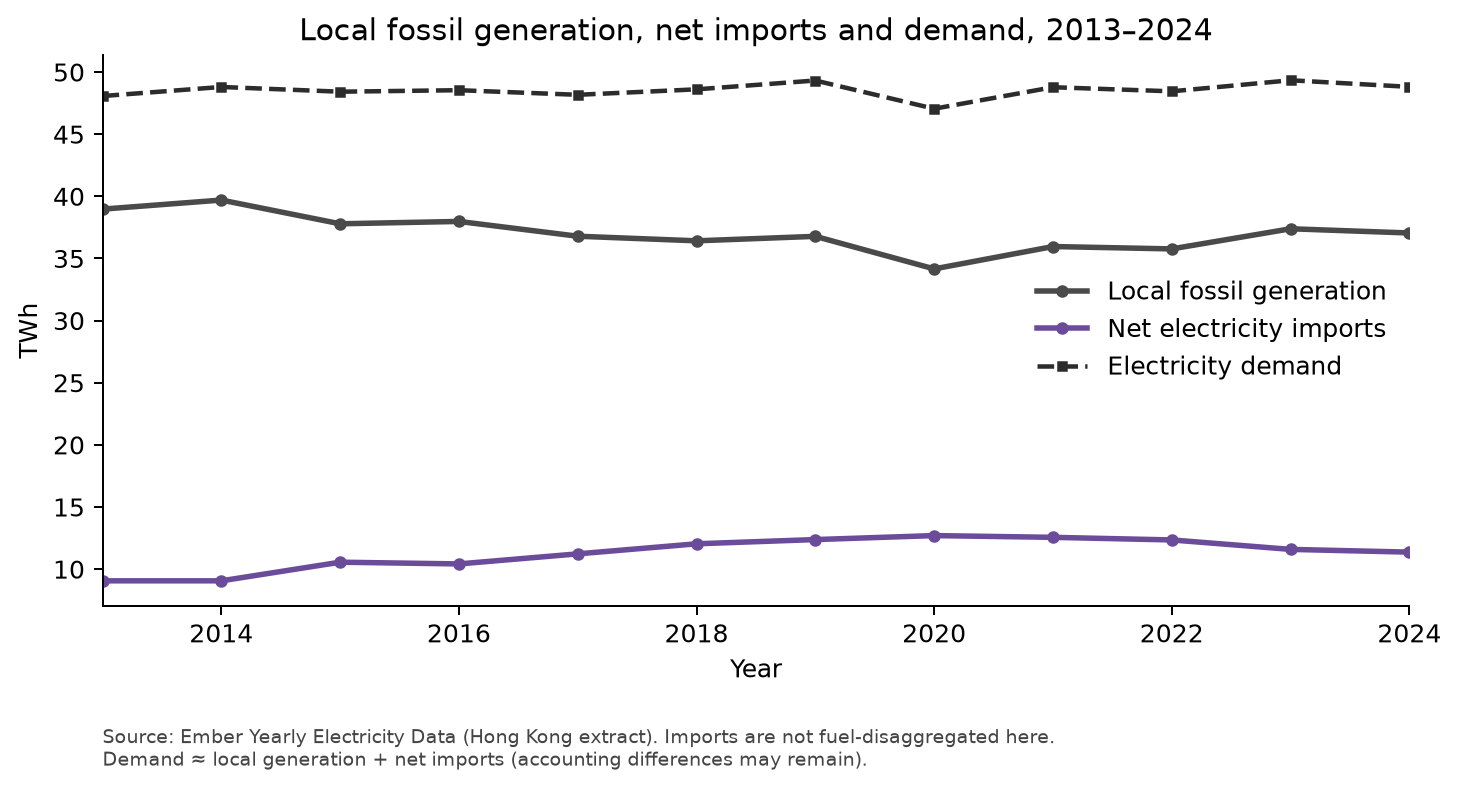
Looking ahead, Hong Kong’s clean power plan leans on stronger transmission links with the Mainland, with major reinforcement expected around 2026. That can deliver large volumes of lower carbon electricity that Hong Kong cannot easily generate on its own land. It also means reliability depends on cross border infrastructure, contracts, and upstream supply, not only on local power stations.
This is the quiet security lesson. Celebrating lower coal use is not enough. Cities also need to ask: what new dependencies are we building, and how resilient are they under heatwaves, fuel shocks, or transmission constraints?
4. Why renewable energy alone cannot solve the challenge
Local renewables matter. Official planning also shows their limits in arithmetic anyone can follow.
By 2035 or earlier, Hong Kong aims for:
- about 7.5 to 10% local renewable energy in the electricity mix
- about 60 to 70% zero carbon energy overall
- from roughly one quarter zero carbon energy today
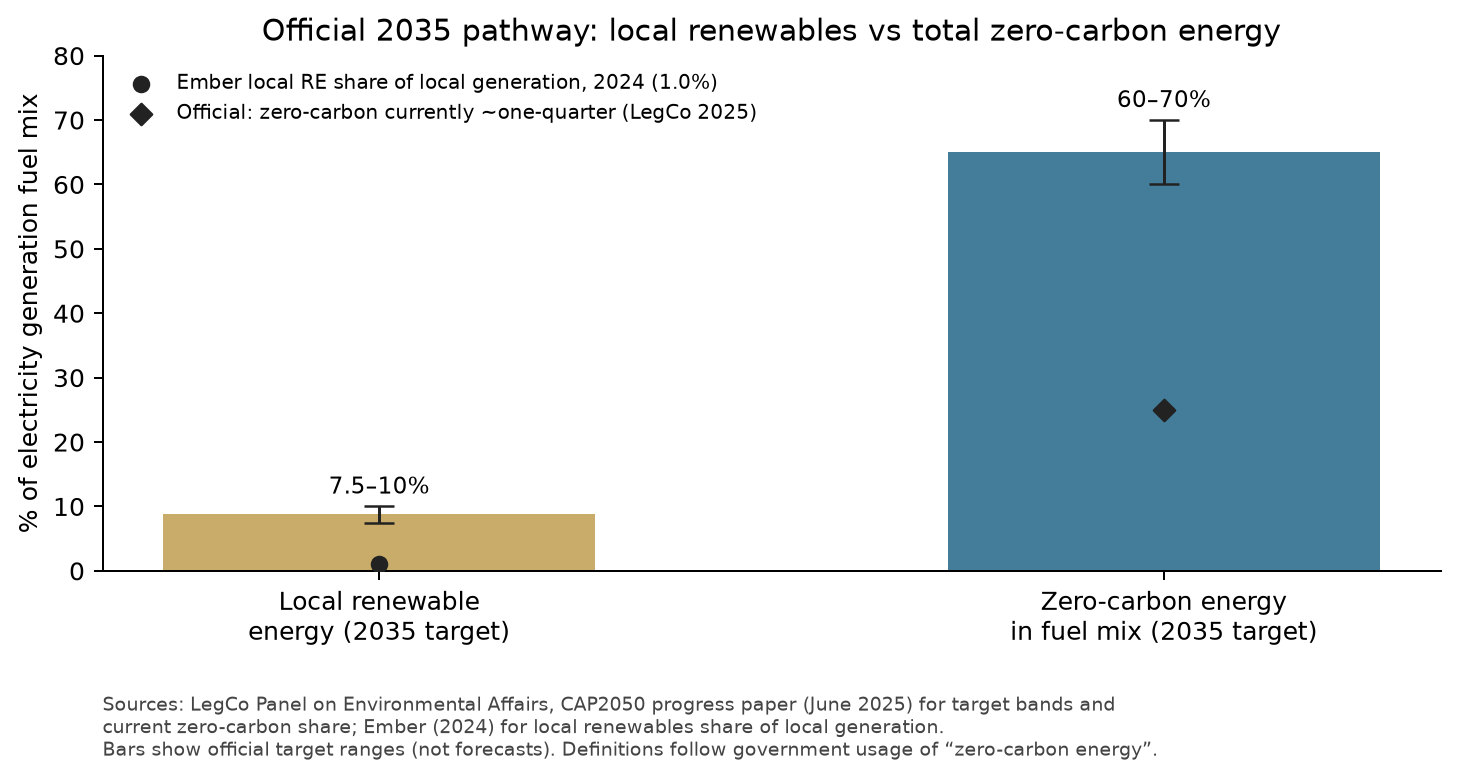
The gap between those two targets is the heart of the strategy. Most of the planned clean power increase is not expected to come from local solar alone. It depends on a broader category of zero carbon supply, including regional imports and transmission.
That does not make local renewables pointless. Feed in Tariffs, waste to energy, and public projects diversify supply. Under current official targets, they simply cannot replace the need for larger zero carbon volumes from elsewhere.
For dense Asian cities, the warning is clear: a solar headline is not the same thing as a deliverable electricity pathway.
5. The overlooked solution: reducing demand through buildings
If clean supply is hard to scale locally, the size of demand matters.
Buildings use about 90% of Hong Kong’s electricity. Commercial premises dominate. In practice, the electricity system is a skyline of offices, malls, hotels, and data heavy commercial loads, not a map of factories.
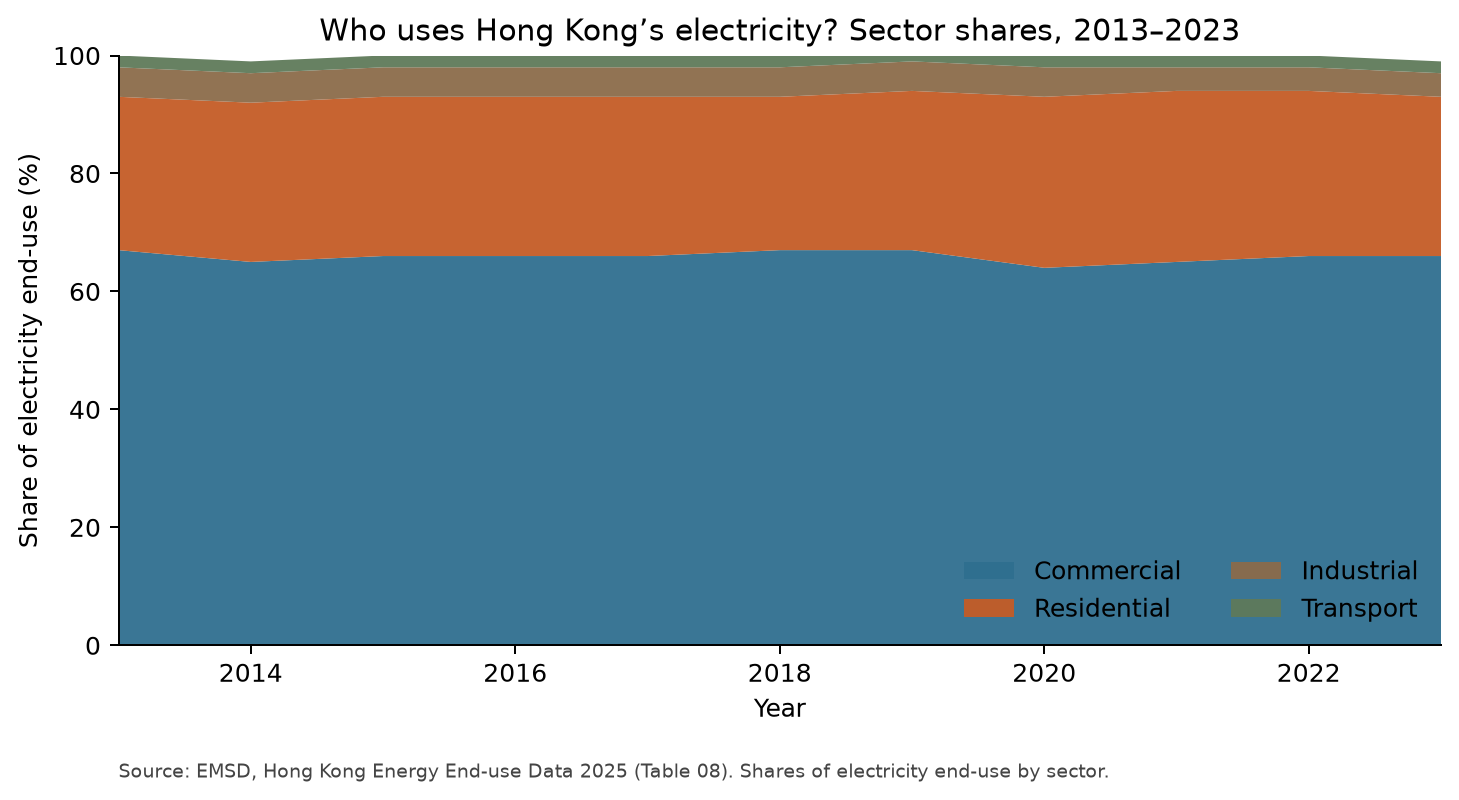
Cooling is the standout end use. Air conditioning now accounts for about 30% of electricity use, up from 27% a decade earlier. In a hotter climate, that load is a resilience issue as much as an efficiency issue.
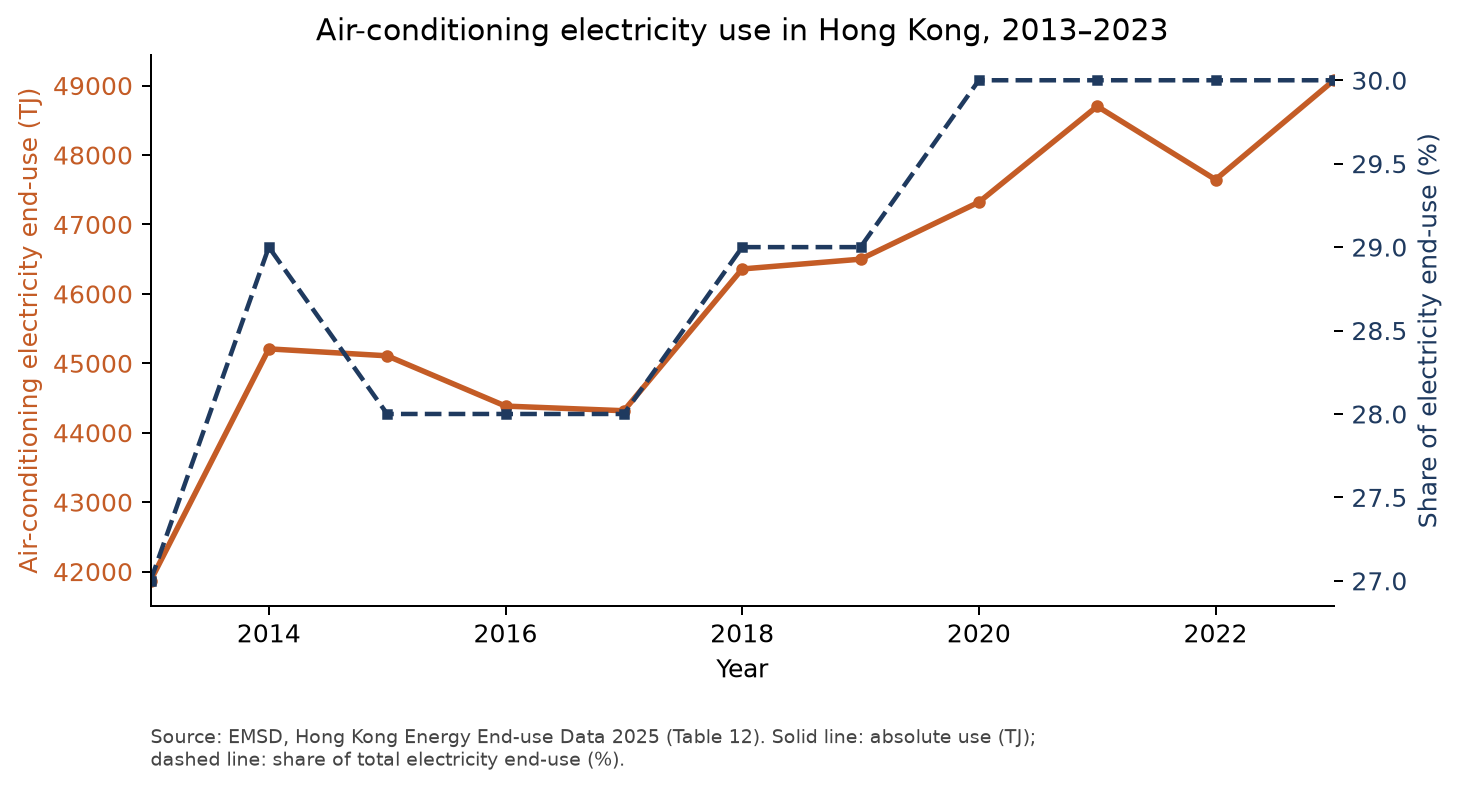
Hong Kong’s own strategy treats building efficiency as transition economics. Using less electricity shrinks the amount of zero carbon power the city must secure. That is not a soft “green buildings” add on. It is how a land constrained city keeps the supply challenge manageable.
This article does not claim household bills have become cheaper or more expensive; the tariff evidence was not assembled here. The policy logic still stands: demand reduction is one of the few tools that can ease climate, security, and cost pressures at the same time.
6. Lessons for Asia's high density cities
Hong Kong’s institutions are hard to export. Its problem structure is not.
Name the transition accurately. Moving from coal to gas can cut emissions quickly. Calling that a finished clean energy transition invites complacency.
Plan a portfolio, not a single technology. Local renewables, transitional gas, building efficiency, and zero carbon imports solve different parts of the problem.
Treat security as a moving target. After coal, watch gas logistics and cross border electricity links.
Put buildings and cooling at the centre. Where commercial and air conditioning loads dominate, efficiency and peak management reduce how much clean supply a city must procure.
Ask diagnostic questions before announcing capacity targets. How large is electricity in total emissions? How much local renewable land is realistic? How big is cooling demand? What import or interconnection options exist?
What should not be copied blindly: Hong Kong’s specific utility regulation, the politics of any one cross border link, or local siting choices for LNG and waste to energy.
Conclusion
Hong Kong shows that a high density city can cut power sector emissions without waiting for a local renewable boom. Coal to gas switching, continued electricity imports, and a focus on buildings have already moved the needle.
The harder test is still ahead: building a mostly zero carbon electricity system while managing gas and interconnection risks, and keeping cooling driven demand under control.
The cities that plan demand, local renewables, and governable zero carbon imports together will be the ones that turn climate ambition into a system that still works on the hottest days of the year.
Sources
Key public sources include Hong Kong’s Climate Action Plan 2050 materials; the June 2025 Legislative Council progress update; Electrical and Mechanical Services Department energy end use data; the official greenhouse gas inventory; Scheme of Control agreement documents; Ember’s yearly electricity data (used for local generation trends, with the accounting caveat above); and IEA analysis on electricity grids and secure transitions.